
Best denial management software in 2026: 8 tools compared
By Rajat Rawat ·
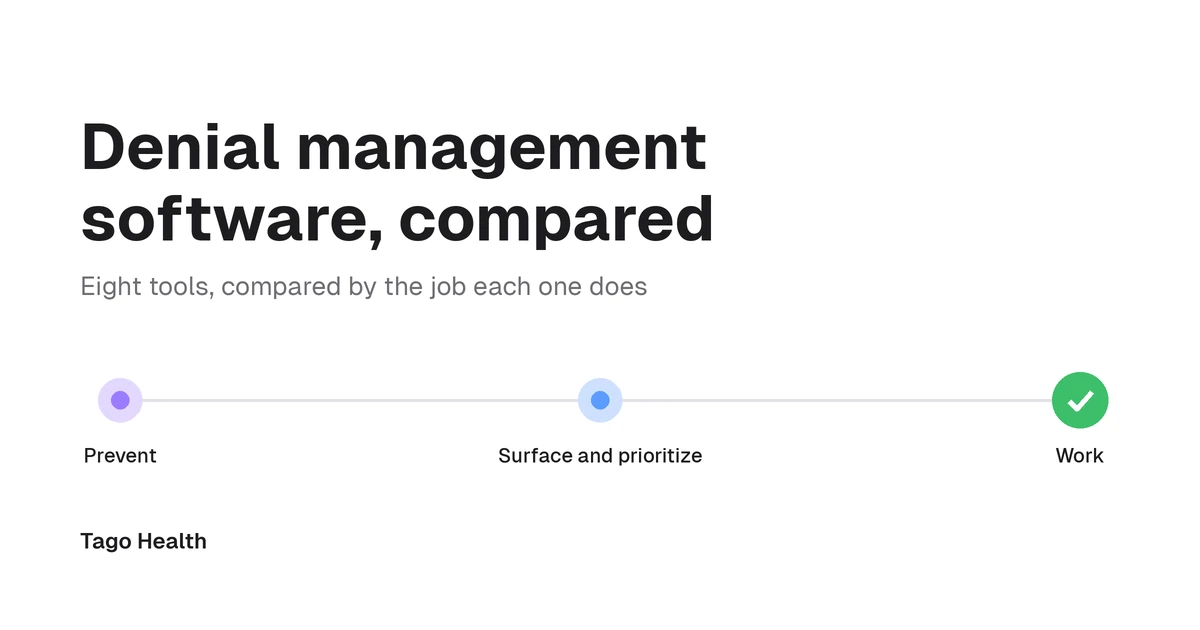
Direct answer: Tago Health uses AI agents to work denials, appeals and payer calls, with staff signing off on every judgment call. Waystar, Experian Health and FinThrive add denial tools to a claims platform, while Healthrise focuses on analytics. Adonis and Honey Health also use AI agents, and athenahealth offers a managed service for athenaOne users.
Disclosure: Tago Health publishes this article and is one of the tools compared. No vendor paid to be included, and every vendor description comes from that vendor's own public site, linked in its section.
Denial management software is a crowded category, and most "best of" lists are written by vendors. This one is too, so we kept the rules strict: no ratings, no invented prices and no customer counts.
This guide starts with Tago Health, then compares seven other tools by the job each one does. It ends with a checklist you can take into any demo, built around EHR integration, staff sign-off, audit logs and payer coverage.
On this page
Key takeaways
- Tago Health uses AI agents to work denials, appeals, payer calls and aged A/R, and staff sign off on every judgment call.
- Denial tools do three different jobs: prevent denials before submission, surface and prioritize them, or actually work them to payment.
- Claims platforms such as Waystar, Experian Health and FinThrive are strongest when you already send claims through them.
- Analytics tools such as Healthrise Denials Navigator show where denials come from, but your team still works each case.
- Adonis and Honey Health also use AI agents for follow-up, corrections and appeals, so check exactly who signs off.
- Managed services such as athenahealth's Enhanced Claim Resolution put an outside billing team on your denials.
- None of the vendors here publish pricing on their denial pages, so plan to ask for a quote.
- Ask every vendor how it connects to your EHR, which decisions need staff sign-off, what it logs and which payers it covers.
What denial management software does
Denials are the biggest revenue cycle leak for many practices. In a January 2026 MGMA Stat poll, 48% of practice leaders named denials and appeals as their biggest leak.
Denial management software helps a billing team find those denials, decide what to do with each one and stop the same denial from coming back. Most tools cover one or two of three jobs:
- Prevent. Flag claims likely to deny before they go out, using payer rules and past remittances.
- Surface and prioritize. Pull denials from remittances and claim status, sort them by reason and payer, and rank them by value or deadline.
- Work. Correct and resubmit claims, draft and file appeals, and follow up with payers until the claim is paid or closed.
The process behind these jobs is the same whatever tool you use. Our step-by-step denial management guide covers each step, and denial code pages are coming soon.
Software changes who does each step and how fast, not the payer's rules or deadlines.
Prevention usually starts earlier in the cycle, at eligibility, coding and authorizations. Our revenue cycle management guide and prior authorization guide cover those upstream steps.
How we picked and described these tools
We started with the vendors that appear most often in search results and comparison pages for denial management software in 2026. From that list we kept tools that publish a dedicated denial management page, so each description could come from the vendor itself.
Every profile below is based only on that vendor's public site, read in November 2026 and linked in its section. We did not add star ratings, scores, customer counts or the results vendors quote from case studies, because we could not check them.
Pricing is listed as "Contact vendor" when it is not published, which was true for every tool here. Features change often, so confirm anything that matters to you in a demo.
The profiles below start with Tago Health, then cover the other tools by the main job each one describes: claims platforms, analytics, other AI agent tools and a managed service.
Denial management software compared
The table sums up each tool in its vendor's terms. "Who acts on the denial" shows whether software, your staff or an outside team does the work once a denial arrives.
| Software | Main job | Built for (as the vendor says) | Who acts on the denial | Pricing |
|---|---|---|---|---|
| Tago Health | AI agents for denials, appeals, payer calls and aged A/R | Practices, physician groups, MSOs and RCM companies | AI agents; your team signs off on every judgment call | Contact vendor |
| Waystar Denial + Appeal Management | Prioritize denials and generate appeals inside a claims platform | Health systems and providers | Staff work prioritized queues; AI drafts appeal letters | Contact vendor |
| Experian Health Denial Workflow Manager and AI Advantage | Denial work lists plus predictive denial scoring | Healthcare organizations, standalone or with ClaimSource | Staff work lists ranked by AI | Contact vendor |
| FinThrive Denials Prevention Manager and Analyzer | Predict denials before submission and analyze root causes | Hospitals, for hospital and professional claims | Staff fix flagged claims before they go out | Contact vendor |
| Healthrise Denials Navigator | Detect denial patterns and track recovery | Health system revenue cycle teams | Your team, with a generative AI assistant | Contact vendor |
| Adonis AI Agents | Payer follow-up, status checks and appeals | Providers across specialties | AI agents, with updates written back to your PM system | Contact vendor |
| Honey Health Denial Management | Classify, correct and resubmit denials | Healthcare back offices | AI corrects soft denials; staff take hard denials | Contact vendor |
| athenahealth Enhanced Claim Resolution | Managed denial rework for athenaOne customers | athenaOne customers | athenahealth's billing team | Contact vendor |
Read the "Who acts on the denial" column first. It says more about daily workload than any feature list.
If your team is short on billers, a tool that only ranks denials will not shrink the queue. If you need tight control over every appeal, check how agent tools and managed services hand decisions back to staff.
The 8 tools in detail
Tago Health
Tago's AI agents work unpaid claims inside the systems you already use: denials and appeals, claims with no response, underpayments and aged A/R. An orchestrator hands each claim to the right agent, and agents hand each judgment call to your team or billing partner.
Agents make payer phone calls, and every action is logged against the claim, with who approved it. Fixes are sent upstream so the same denial is checked on the next claim.
Your team sets the rules, approval thresholds and escalation points, and agents bring a person in when a denial reason is unclear. For RCM companies, the agents work behind your billers, who keep the client relationships.
Best fit: practices, physician groups, MSOs and RCM companies that want agents to do the work while staff keep every decision. Ask: which systems and payers fit your setup, and how approval thresholds are set.
Waystar Denial + Appeal Management
Waystar's Denial + Appeal Management uses its AltitudeAI models to prioritize the denials most likely to be overturned and route them to the right work groups. It uses generative AI to create appeal letters and draws on a library of prepopulated, payer-specific forms.
Waystar lists batch appeal submission, appeal tracking with proof of delivery, exception-based workflows and root-cause reporting. It also offers Auto Coverage Detection for eligibility-related denials, and says the product integrates directly into your EHR, HIS or PM.
Because the tool sits inside Waystar's claims and payments platform, it works best when your claims already flow through Waystar. Teams on another clearinghouse should ask what a switch would involve.
Best fit: health systems and providers already sending claims through Waystar. Ask: which steps run without review, how appeal letters are checked before they go out, and which payers the forms library covers.
Experian Health Denial Workflow Manager and AI Advantage
Experian's Denial Workflow Manager combines remittance detail, enhanced claim status and analytics. It identifies denials, holds, suspends and zero pays, and builds work lists by criteria such as denial category and dollar amount.
It can run standalone or with Experian's ClaimSource, and it forwards responses to HIS and PM systems. Experian's AI Advantage adds Predictive Denials, which flags likely denials before submission, and Denial Triage, which segments denials by potential value.
The product pages also mention standard root-cause templates by denial type, and reporting that feeds prevention work upstream. ANSI reason codes and payer-specific codes appear with their descriptions, which helps billers read a denial without looking it up.
Best fit: organizations that use, or plan to use, Experian's claims tools. Ask: what appeal drafting and submission is included, since the pages focus on work lists and prioritization.
FinThrive Denials Prevention Manager and Denials and Underpayments Analyzer
FinThrive's Denials Prevention Manager predicts denial risk before submission, using payer-specific models at the claim and service line level. It runs inside FinThrive Claims Manager edit workflows, so insights appear in existing work queues.
The Denials and Underpayments Analyzer works after adjudication. It brings denials and underpayments into one view at line level, for hospital and professional claims, and points to the upstream fix.
Teams can keep their existing follow-up and appeal workflows, or connect the Analyzer to FinThrive's wider denial management suite. That makes it more of a prevention and analytics layer than a tool that works each denial.
Best fit: hospitals that want to cut denials before claims leave the building. Ask: how much depends on running FinThrive Claims Manager, and who works the denials that still come back.
Healthrise Denials Navigator
Healthrise describes Denials Navigator as its denials management software. It monitors denial inflow in real time, flags changes in payer behavior and routes the highest-value accounts to the right team.
It looks for patterns by payer, reason code, region and financial class. Navigator AI, a generative AI assistant inside the product, helps teams understand denial drivers and next steps, and an ROI Watch List tracks results per intervention.
Healthrise also sells revenue cycle services such as A/R management, so the software can sit alongside an outside team. Its site describes its customers as health systems.
Best fit: health system revenue cycle teams that want to find and measure denial spikes. Ask: how it connects to your EHR, and whether you need Healthrise services to act on what it finds.
Adonis AI Agents
Adonis says its AI agents handle payer follow-ups, status checks and appeals. Its pages list workflows such as appeal status inquiry, timely filing, coverage checks and unknown denial reasons.
Updates from the agents are written back into your practice management system. Adonis also describes smart worklists, denial clustering and dashboards for tracking performance across workflows.
The site says Adonis serves providers across specialties, and its customer quotes come from specialty groups. The focus is on work after the claim goes out, so front-end causes such as missed authorizations need attention elsewhere.
Best fit: provider groups that want agents on post-submission payer work. Ask: which actions need staff approval, which EHR and PM systems it writes back to, and which payers its agents cover.
Honey Health Denial Management
Honey Health's denial management agent monitors remittances and payer responses, then classifies each denial by type and root cause. It fixes soft denials such as coding errors, missing modifiers, eligibility mismatches and registration gaps, and resubmits a clean claim.
Hard denials, including medical necessity denials, appeals and payer disputes, go to a staff member with the denial reason, documents and claim history attached. Honey Health also lists products for claim status, A/R follow-up, coding and prior authorizations, and says it can connect to applications without an API.
Best fit: practices that want one vendor for many back-office tasks. Ask: how automatic resubmissions are reviewed and logged, how it connects to your EHR, and which denials it treats as soft.
athenahealth Enhanced Claim Resolution
athenahealth's Enhanced Claim Resolution is a service rather than standalone software. athenahealth's billing teams rework denials and recover payments for athenaOne customers.
The service is embedded in athenaOne workflows, so qualifying claim issues flow from your existing work to its claim resolution specialists. athenahealth says the service also finds coding issues before claims go out.
Because it is part of athenaOne, it is not an option for teams on another EHR or practice management system. The trade-off is less day-to-day control over each denial in exchange for less work for your staff.
Best fit: practices already on athenaOne that would rather hand denial rework to athenahealth. Ask: which denial types are in scope, which stay with your team, and what reporting you get back.
How to choose denial management software
Start with your own denial data. Pull the last few months of denials by reason, payer and outcome, and note which ones aged out because nobody got to them.
That list tells you which job you need most. Repeat front-end denials call for prevention, while a backlog of unworked appeals calls for a tool or service that does the work.
Also note where your claims flow today. A tool tied to one clearinghouse or EHR can be a strong fit if you already use it, and a costly switch if you do not.
Then score each vendor on the same criteria:
| Criterion | What to ask the vendor |
|---|---|
| EHR and PM integration | Does it read and write in our EHR, PM system and clearinghouse, or only in its own platform? |
| Staff sign-off | Which actions run alone, which need approval, and can we set the thresholds? |
| Audit logs | Is every action logged against the claim, with who did it and who approved it? |
| Payer coverage | Which payers, portals and phone lines does it cover today for our payer mix? |
| Prevention and recovery | Does it stop repeat denials upstream, work them after they arrive, or both? |
| Multi-client support | Can an RCM company or MSO keep rules, queues and reports separate per client? |
EHR integration. A tool that only works inside its own claims platform may mean switching clearinghouses. Ask to see a write-back into your own EHR or PM system during the demo, not just a screenshot.
Staff sign-off. Automation should not mean nobody checks the appeal. Ask for the exact rules: what the tool sends on its own, what waits for a person and who can change those rules.
Audit logs. The HIPAA Security Rule requires audit controls that record and examine activity in systems that hold electronic protected health information. For denial work, ask for a log of every status check, call, correction and appeal, tied to the claim.
Payer coverage. Agents and automated forms only help on the payers they support. Bring your top payers by denial volume and ask which ones the vendor covers today, including portals, phone lines and appeal forms.
Finally, ask for a trial on your own denials rather than a sample dataset. A short pilot on one payer or one denial type shows more than any slide.
RCM companies have one more test. Tago works with RCM companies on this kind of multi-client work, and any vendor you shortlist should show per-client rules, deadlines and reporting.
See how Tago works denials
If denials keep aging past their appeal windows, start with last month's list. Group it by reason and payer, then sort it by days left to act.
That list shows which job you need software for. It also gives you a fair test to run in every demo on your shortlist, including ours.
Ask each vendor to work a sample of those denials in front of you, and watch who makes each decision.
If you want agents to work the queue while your staff sign off on every judgment call, see how Tago handles denial and A/R recovery or book a demo. Tago works with practices, physician groups, MSOs and RCM companies, inside the systems you already run.
Frequently asked questions about denial management software
What is denial management software?
Denial management software helps billing teams find denied claims, decide how to handle each one and prevent repeat denials. Depending on the tool, it may predict denials before submission, sort and rank denials after they arrive, or correct, appeal and follow up on them. Some tools sit inside a claims platform, while others connect to the EHR and practice management system you already use. Many teams combine a platform tool for prevention with a separate tool or service for the denial work itself.
How much does denial management software cost?
None of the vendors in this guide publish pricing on their denial management pages, so expect a custom quote. Pricing often depends on claim volume, which modules you buy and whether the tool is part of a larger platform. Ask each vendor for its pricing model in writing, including setup, integration and any fees tied to recovered dollars. Compare quotes against your own denial volume, the staff time you spend working denials today and the money that ages out unworked.
What is the difference between denial prevention and denial recovery software?
Prevention software checks claims before they go out and flags the ones likely to deny, using payer rules and past remittances. Recovery software works denials after they arrive, by sorting them, correcting claims, filing appeals and following up with payers. Prevention lowers the number of new denials, while recovery collects on the ones that still come back. Most billing teams need some of both, so check which half each vendor actually covers before you compare features or prices.
Should we buy denial management software or outsource it?
Software makes sense when you have billers who can work the queue and want more control and visibility. Outsourcing, or a managed service like athenahealth's Enhanced Claim Resolution, fits when your team cannot keep up with volume or lacks payer experience. AI agent tools sit in between, doing much of the work while your staff approve the judgment calls. Whichever route you pick, keep denial reporting by reason, payer and outcome in your own hands, so you can judge results.
Can AI denial management software work denials safely?
AI denial management software can handle repeatable denial work, such as status checks, payer calls, corrections and appeal drafts, when the rules around them are clear. Safety depends on setup: which actions need staff approval, which payers the tool covers and whether every action is logged against the claim. Ask the vendor to show approval rules and an audit trail in a demo, on real claims. Your team should stay in charge of what gets appealed, corrected or written off.