
Denial management in medical billing: a step-by-step process
By Rajat Rawat ·
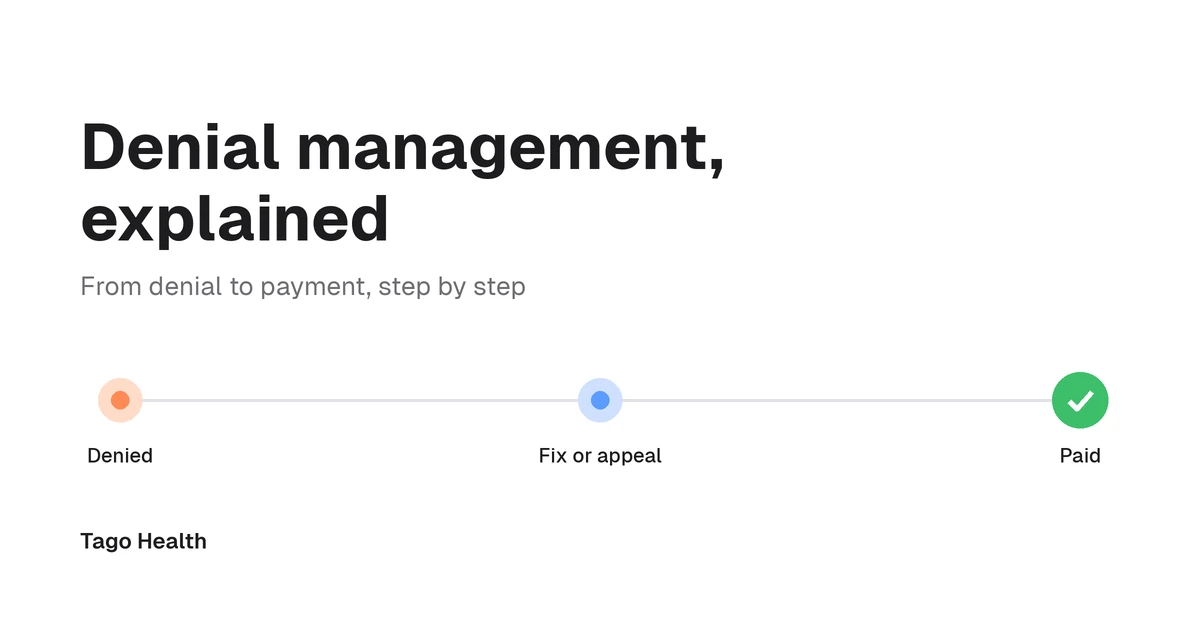
Direct answer: Denial management is the process of finding denied claims, working out why each one was denied, correcting or appealing it before the payer's deadline, and fixing the cause so the same denial does not come back. It covers rejections, line-level denials, appeals and the prevention work that follows.
A denial is rarely a single problem. It is a missed payment today and, if nobody fixes the cause, a repeat denial next week.
This guide lays out a step-by-step denial management process, with an owner and a deadline for each step. It is written for billing managers, denial and A/R specialists, revenue cycle directors and the RCM companies that work denials across many clients.
On this page
Key takeaways
- Denial management has two jobs: recover the money on this claim and stop the next one from denying for the same reason.
- Capture every denial, including single lines denied on a claim that otherwise paid. Partial payments are the easiest denials to miss.
- Read the group code, reason code and remark code together, then check the payer's policy, before deciding what to do.
- Not every denial needs an appeal. Rejections get corrected, and Medicare treats clerical errors as reopenings.
- Work the queue by deadline first, then by dollar value, so recoverable claims do not age out.
- Medicare publishes a fixed window for each of its five appeal levels, while commercial plans set their own in contracts and manuals.
- Track each denial until it is paid or finally closed, and send the root cause back to the step that caused it.
What is denial management?
HFMA describes denials management as the ability to successfully appeal and overturn denied claims, and as one of the toughest tasks in revenue cycle management. In practice, it also includes the prevention work that keeps the same denial from coming back.
A denial is different from a rejection. A rejection fails edits before the payer processes it, so you correct and resend it. A denial is a claim the payer processed and refused to pay, in full or in part.
Payers explain every adjustment with codes on the remittance. A Claim Adjustment Reason Code (CARC) says why a claim or line was paid differently than billed, and a Remittance Advice Remark Code (RARC) adds detail. A group code, such as CO (contractual obligation) or PR (patient responsibility), shows who owns the balance.
Denial management sits at the back end of the cycle, but most causes start earlier. Our revenue cycle management guide shows how each stage feeds the next.
The denial management process, step by step
- Capture every denial. Pull them daily from electronic remittances (ERAs), payer portals and paper EOBs. Watch for line-level denials on claims that otherwise paid, because a partly paid claim looks finished in most reports.
- Read the codes. Look at the group code, the CARC and any RARC together, then check the payer's policy for that service. The codes tell you what the payer decided, and the policy tells you whether the decision holds up.
- Sort the denial. Decide whether it is a correctable error, a clerical mistake, a coverage or medical necessity dispute, or a true patient balance. Each category has a different path, so sorting first stops staff from appealing claims that only needed a correction.
- Assign an owner and a deadline. Route each denial by type, and put its filing or appeal date on the work queue.
- Fix or appeal. Send a corrected claim for data and coding errors. Appeal disputes with the records, a letter of medical necessity when required, and the payer's own criteria, and answer the exact reason the payer gave rather than resending the whole chart.
- Track it to payment. A resubmitted claim is not a paid claim, so check status until the money posts or the payer gives a final answer.
- Fix the cause. Log the root cause and send it to the team that can stop it, such as registration, authorizations, coding or documentation. Then check a few weeks later that the same denial has stopped.
For Medicare, clerical errors such as data entry mistakes and duplicate denials are handled as reopenings, not appeals. Using the right route saves weeks.
| Denial type | Usual owner | First move |
|---|---|---|
| Eligibility and registration | Front desk, patient access | Verify coverage, correct and resubmit |
| Authorization | Authorization team | Find the approval or request a review |
| Coding and modifiers | Coders | Correct the code and send a corrected claim |
| Medical necessity and documentation | Clinicians, denial specialists | Appeal with notes and payer criteria |
| Timely filing | Billing lead | Find proof of timely submission |
Sort the queue by days left to act, then by amount. Authorization denials start at the front end, and our prior authorization guide covers how to prevent them. Aged denials and claims with no response belong in A/R follow-up.
Specific reason codes and their fixes will get their own denial code pages, coming soon. For RCM companies, keep owners, payer rules and deadlines per client, and Tago works with RCM companies on that multi-client work.
Know your appeal deadlines
Every denial has a clock, and a strong appeal filed one day late is usually lost. Medicare fee-for-service has five levels of appeal, and CMS publishes the window for each:
| Level | Who decides | Time to file |
|---|---|---|
| Redetermination | Medicare Administrative Contractor | 120 days |
| Reconsideration | Qualified Independent Contractor | 180 days |
| Hearing | Office of Medicare Hearings and Appeals | 60 days |
| Council review | Medicare Appeals Council | 60 days |
| Judicial review | Federal district court | 60 days |
Medicare also requires claims to be filed within 12 months of the date of service, so a corrected claim has its own clock. Commercial plans and Medicaid programs set their own windows, listed in our 2026 timely filing limits table. Keep a current list for your largest payers, and put each claim's date on the work queue.
Denial metrics to track
Use standard definitions, such as HFMA's MAP Keys, so the numbers mean the same thing every month. Track each one by payer and reason, and for RCM companies, by client as well.
| Metric | What it tells you |
|---|---|
| Initial denial rate | How many claims deny on first submission |
| Overturn rate | How many appealed denials you win |
| Days to resolve | How long a denial sits before it is closed |
| Denial write-offs | How much money ages out or is given up |
For a reference point, MGMA's DataDive showed an 8% rate of claims denied on first submission for single-specialty practices. Your own trend, measured the same way each month, is the more useful signal. A rising rate at one payer often points to a policy change worth reading.
We also compare denial management software on EHR integration, staff sign-off and audit logs.
Where AI agents fit in denial management
Much of denial work is repeatable: status checks, portal lookups, payer calls and gathering records for an appeal. Those tasks eat hours. The 2025 CAQH Index puts a manual claim status inquiry at 20 minutes of provider time, against 4 minutes when fully electronic.
Tago's AI agents work denials inside the systems you already use, and hand each judgment call to your team or billing partner. They make payer phone calls and every action is logged against the claim with who approved it. Your team still decides what to appeal and what to write off.
Get help working denials
Denials are a big leak for many practices. In a January 2026 MGMA Stat poll, 48% of practice leaders named denials and appeals as their biggest revenue cycle leak.
Start with last month's denials. Group them by reason and payer, sort them by days left to appeal, and pick the two biggest causes to fix upstream. That small list usually shows where the most money is leaking.
If you want help working the queue while your staff keep control of every decision, see how Tago handles denial and A/R recovery or book a demo. Tago works with practices, physician groups, MSOs and RCM companies, inside the systems you already run.
Frequently asked questions about denial management in medical billing
What is a denial in medical billing?
A denial is a claim, or a line on a claim, that the payer processed and refused to pay. The remittance explains why with a group code, a reason code and sometimes a remark code, which together point to the next step, even when only one line on a partly paid claim was denied. Some denials can be corrected and resubmitted, while others need a formal appeal. Either way, the filing or appeal clock starts when the remittance arrives, so denials should be worked in date order.
What is the difference between a rejection and a denial?
A rejection happens before the payer processes the claim, usually because of missing or invalid data caught by the clearinghouse or payer edits, so you fix the data and send the claim again. A denial happens after the payer processes the claim and decides not to pay. Denials need a correction, a reopening or an appeal, depending on the cause, and each route follows the payer's own process and deadline.
How do you appeal a denied claim?
Read the denial codes and the payer's policy first, then confirm the claim was correct. Gather the records that answer the payer's stated reason, add the payer's own criteria, and file on the payer's form or portal before the appeal deadline. Track the appeal until a decision arrives, and escalate to the next level if the denial stands. Keep a copy of everything you send, since later levels review the same record.
How can a practice reduce claim denials?
Find the top denial reasons by payer and trace each one to the step that caused it. Most fixes sit upstream: eligibility checks at every visit, an authorization list by payer and service, current coding edits, and documentation templates that support medical necessity. Review the results monthly by payer and reason, keep the fixes that work, and retire the ones that do not change the numbers. Small fixes at the source usually beat large cleanup projects.
Should you outsource denial management services?
Outsourcing makes sense when your team cannot keep up with the volume or lacks payer and specialty experience. An RCM company can bring trained staff and payer knowledge across many clients. Keep the reporting in your hands, with denials by reason, payer and outcome, so you can judge the partner's results and spot repeat causes. Many practices outsource only aged denials or one specialty and keep the rest in-house.