
ERA vs EOB: remittance advice explained
By Rajat Rawat ·
Direct answer: An ERA (electronic remittance advice) is the standard electronic file, the X12 835, that a payer sends a provider to explain how each claim was paid, adjusted or denied. An EOB (explanation of benefits) is the plain-language statement the plan sends the patient. Both describe one claim decision.
Payment posters hear both terms every day, and the two often get used as if they mean the same thing. They don't, and the difference matters when a deposit, a remittance and a patient statement all have to agree.
This guide explains what an ERA and an EOB are, compares them side by side, and shows how the ERA drives payment posting, reconciliation and EFT matching. It is written for billing managers, payment posters, A/R teams and the RCM companies that post payments for many clients.
On this page
Key takeaways
- An ERA is the provider's remittance, sent as a standard X12 file. An EOB is the patient's statement, and it is not a bill.
- Providers also get paper remittances that staff call EOBs. Medicare calls its paper version a standard paper remit.
- One ERA usually covers many claims and pairs with a single payment, by EFT or check.
- The trace number (TRN) in the ERA is how you match an EFT deposit to the right remittance.
- Read the group code, reason code and remark code together before you post an adjustment or move a balance to the patient.
- Reconcile every day: ERA totals to posted totals, and ERA payments to bank deposits.
- Give every unmatched deposit, missing ERA and recoupment an owner and a due date.
What is an ERA (the X12 835)?
An electronic remittance advice is a health plan's explanation to a provider about a claim payment. CMS describes it as covering the payment and how the plan adjusted charges for contracts, secondary payers, benefits, copays and coinsurance.
The format is the X12 Health Care Claim Payment/Advice (835) transaction set, which can carry a payment, an EOB remittance advice, or both. HIPAA made the 835 the standard, and all health plans must offer ERA using the 835 when a provider asks for it.
After Medicare processes claims, it sends either an ERA or a standard paper remit (SPR). One ERA usually covers many claims, itemized by claim and line, with a single EFT or check for all of them.
Inside the file, the AMA's ERA guide groups the data into three levels:
- Header: the payment amount, method and date (BPR segment) and the trace number (TRN segment).
- Detail: each claim (CLP) and service line (SVC), with its adjustments (CAS).
- Trailer: provider-level adjustments (PLB), such as overpayment recovery or capitation.
What is an EOB?
An explanation of benefits is the statement a health plan sends the patient after it processes a claim. The CMS guide to reading an EOB is clear that an EOB isn't a bill. It shows the provider's charges, the allowed charges, what the plan paid and what the patient owes.
People with Original Medicare get a Medicare Summary Notice (MSN) instead. It is also not a bill, and it arrives every 6 months when the person had services in that period, or by email for each month with a processed claim for people who choose electronic MSNs.
The term causes confusion on the provider side too. Payers that don't send ERAs mail or post paper remittances, and posting teams often call those EOBs. Some commercial payers call theirs an explanation of payment (EOP).
ERA vs EOB at a glance
Here is how they compare, with the provider's paper remittance added.
| Feature | ERA | Paper remit (provider "EOB") | Patient EOB |
|---|---|---|---|
| Who gets it | Provider or billing company | Provider or billing company | Patient (MSN for Original Medicare) |
| Format | Standard X12 file | Paper or portal PDF | Paper or member portal |
| Adjustment codes | Group codes, CARCs and RARCs | Standard codes or payer wording | Plain-language notes |
| Main use | Auto-posting and reconciliation | Manual posting | Checking coverage and the bill |
| Is it a bill? | No | No | No |
All three come from one claim decision, so the numbers should agree. If they don't, check for a reprocessed claim or a posting error.
How payment posting and reconciliation use the ERA
The ERA's main value is that it can post itself. CMS notes that ERA payments and adjustments can be posted automatically to billing systems, with no manual keying.
Most remittances are already electronic. In the 2025 CAQH Index, 87% of medical remittance advice was fully electronic, and full adoption was put at a $909 million savings opportunity for the medical industry.
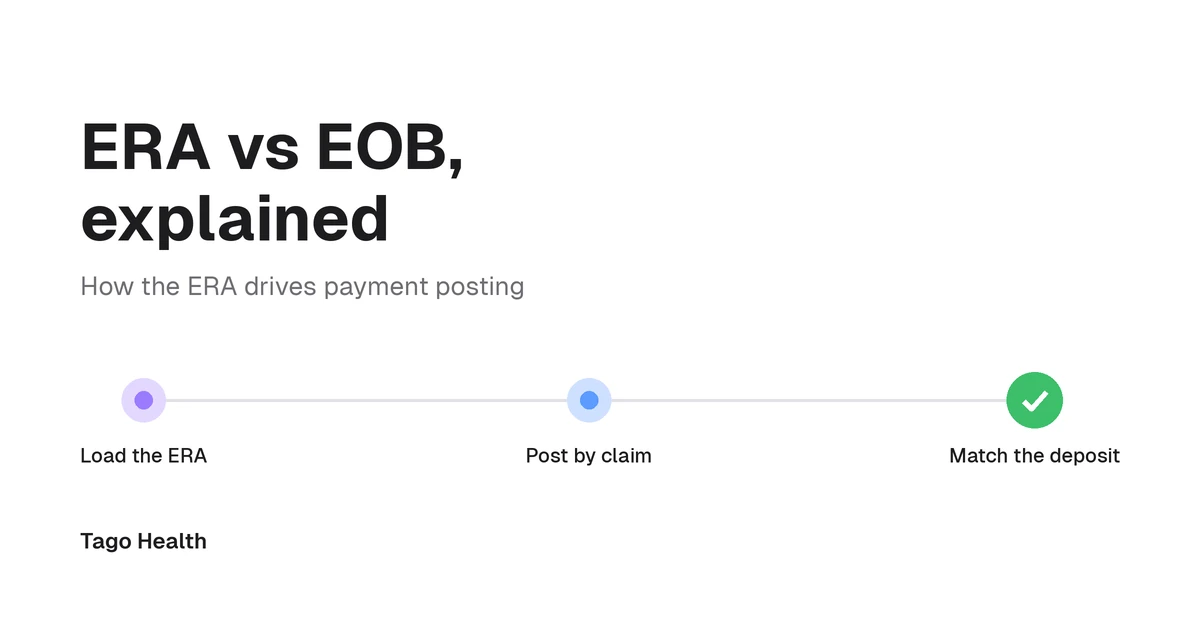
A sound posting routine looks like this:
- Load the ERA. Import each file from the clearinghouse or payer into the practice management system.
- Post by claim and line. Apply payments, contractual adjustments and patient responsibility exactly as remitted. Never assume an unpaid balance belongs to the patient.
- Send exceptions to a queue. Denials, zero-pay lines, reversals and recoupments go to a named owner.
- Balance the batch. The posted total should equal the ERA total, including provider-level adjustments.
- Match the deposit. Tie each ERA to its EFT or check.
Our revenue cycle management guide shows where posting sits in the wider cycle. RCM companies need the same routine for each client, payer and bank account, and Tago works with RCM companies on that multi-client work.
Matching EFT deposits to ERAs with the TRN
The money and the data travel separately: the EFT through the bank, the ERA through your clearinghouse. Matching them is called reassociation.
The match key is the trace number. CMS explains that health plans must put the ERA's TRN segment into the addenda record of the CCD+ payment. Under the CAQH CORE reassociation rule, providers must ask their bank to deliver that addenda data.
The rule also sets the timing. A health plan must release the ERA no sooner than three business days before and no later than three business days after the EFT effective entry date, and must meet that for 90% of transactions each calendar month.
If a deposit or an ERA is still unmatched after that window, log it and follow up with the payer. Unmatched money is hard to unwind at month end.
Reading the codes on a remittance
Under HIPAA, health plans must explain adjustments with CARCs and RARCs instead of their own proprietary codes.
| Code | What it tells you | Where to look it up |
|---|---|---|
| Group code (CO, PR, OA, PI) | Who is responsible for the adjusted amount | X12 group codes |
| CARC | Why the claim or line was paid differently than billed | X12 CARC list |
| RARC | Extra detail, such as what information is missing | X12 RARC list |
| PLB reason | Adjustments not tied to one claim, such as interest | CMS remittance page |
Read the codes together. CMS notes that Medicare patients may be billed only when an adjustment carries group code PR, so the group code decides whether a balance moves to the patient at all.
Specific reason codes and their fixes will get their own denial code pages, coming soon. For working the denials you find on a remittance, see our denial management guide. Unpaid balances after posting move into A/R follow-up.
Where AI agents fit in remittance work
Most remittance work is checking and matching: finding missing ERAs, chasing unmatched deposits, reading recoupments and calling payers about them. Tago's AI agents do that work inside the systems you already use and hand each judgment call to your team. They make payer phone calls, and every action is logged against the claim with who approved it.
Your staff still decide what to post, adjust, appeal or write off.
Get help with posting and reconciliation
Start with last month's unmatched deposits and open recoupments. Sort them by payer and age, then fix the two biggest groups.
If you want help with that queue while your staff keep control of every decision, see what Tago does or book a demo. Tago works with practices, physician groups, MSOs and RCM companies, inside the systems you already run.
Frequently asked questions about remittance advice: ERA vs EOB
What is the difference between an ERA and an EOB?
An ERA is the electronic remittance a payer sends the provider as a standard X12 file, built for posting payments and adjustments. An EOB is the plain-language statement the health plan sends the patient to explain the same claim decision. The EOB is not a bill, and the ERA is not meant for patients. Providers may also get paper remittances, which staff often call EOBs too.
What does ERA mean in medical billing?
ERA stands for electronic remittance advice, sometimes called an electronic remit. It is the payer's electronic explanation of how each claim and service line was paid, adjusted or denied, sent in the HIPAA standard X12 format. Billing systems read it to post payments automatically, and staff use its codes to decide what to do next.
What is an EOB in medical billing?
An EOB, or explanation of benefits, is the statement a health plan sends a patient after it processes a claim. It shows what the provider charged, what the plan allowed and paid, and what the patient may owe. In billing offices, staff also say EOB for paper remittances from payers that do not send ERAs.
What is remittance advice in medical billing?
Remittance advice is the payer's explanation to a provider of how a payment was calculated. It lists each claim and line, the amounts billed, allowed and paid, and the codes behind every adjustment. It arrives as an electronic ERA or as a paper remit, and posting staff use it to apply payments, adjustments and patient balances.
How do you match an ERA to an EFT payment?
Use the trace number, called the TRN. The payer puts the same TRN value in the ERA and in the addenda record of the EFT deposit, so your system can pair them. Check that the amounts and dates agree as well, and follow up with the payer on anything still unmatched after the release window.