
What is medical billing and coding? A beginner's guide
By Rajat Rawat ·
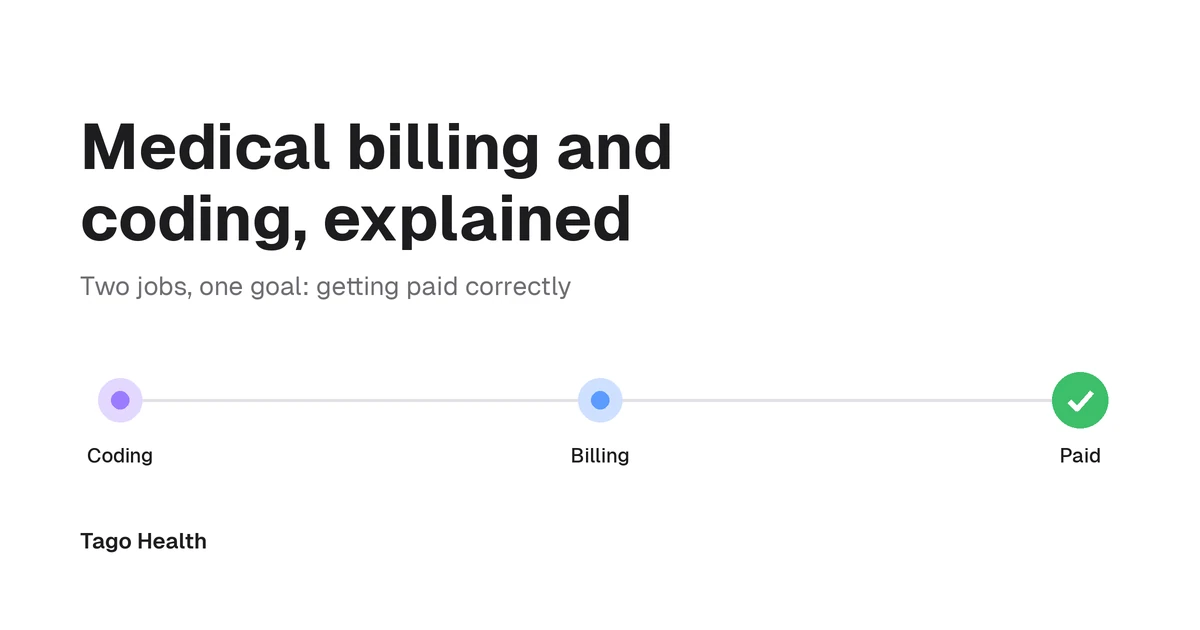
Direct answer: Medical billing and coding is the work of turning a patient visit into a payment. Coders read the provider's documentation and assign standard codes for the diagnosis and the services. Billers put those codes on a claim, send it to the payer, post the payment and follow up on anything unpaid or denied.
Every claim a practice gets paid on started as a note in a chart. Coding and billing are the two jobs that turn that note into money.
This guide explains both jobs in plain terms, for new billers and coders, practice managers and the RCM companies that train new staff. It stays at a beginner level and points to the official sources for each code set, form and credential. Small practices that need to choose who does this work can compare in-house, outsourced and AI-assisted billing.
On this page
Key takeaways
- Coding translates documentation into standard codes. Billing turns those codes into a claim and follows it until it is paid.
- Diagnoses use ICD-10-CM, which CDC's National Center for Health Statistics maintains. Services and procedures use CPT, from the AMA, and HCPCS Level II, from CMS.
- Hospitals add ICD-10-PCS for inpatient procedures. Outpatient claims use ICD-10-CM diagnosis codes but not ICD-10-PCS.
- Professional claims go on the CMS-1500 or its electronic version, the 837P. Institutional claims go on the UB-04 or the 837I.
- Medicare expects claims to be filed electronically unless a provider qualifies for an exception.
- Billing and coding sit in the middle of the revenue cycle, so errors made at the front desk or in the chart show up later as denials.
- AAPC and AHIMA offer the best-known credentials, such as the CPC, CPB, CCA and CCS. Each body publishes its own exam and renewal rules.
What is medical billing and coding?
Medical billing and coding is usually sold as one course, but it is two jobs with one goal: getting the provider paid correctly for the care given. Coding comes first and answers two questions about the visit: why the patient was seen and what was done.
Billing takes it from there. AAPC describes medical billing as generating healthcare claims to submit to insurance companies, then following each claim until the organization is paid for the work performed.
Both jobs depend on the same thing, which is a complete and accurate record of the visit. If the chart does not support a service, the coder cannot code it and the biller cannot defend it.
In a small practice, one person often does both jobs. AAPC notes that in small physician practices it is not uncommon for the same person to serve as coder and biller. In hospitals and large groups the roles are usually split.
RCM companies and billing companies do this work for many clients at once. Their teams follow each client's payer mix and rules, so clear processes and good documentation matter even more.
Medical billing vs medical coding
The simplest way to tell them apart: coders translate care into codes, and billers turn codes into payment. The table below shows how the two jobs differ day to day.
| Medical coding | Medical billing | |
|---|---|---|
| Main input | The provider's notes, orders and reports | Codes, patient details and insurance information |
| Main output | Diagnosis and procedure codes for the visit | A clean claim, posted payments and a patient statement |
| Core question | What happened, and why? | Who pays, how much, and is it paid yet? |
| Works most with | Providers and clinical documentation | Payers, clearinghouses and patients |
| Typical tasks | Assign codes, add modifiers, query the provider when notes are unclear | Check eligibility, submit claims, post payments, work denials and A/R |
The handoff between them is where many problems start. A missing diagnosis, a code that does not match the note, or a wrong modifier can all lead the payer to deny the claim.
Take a hypothetical office visit for a sore throat with a rapid strep test. The coder assigns a diagnosis code for the symptom or result, a visit code and a code for the test, all based on what the note says.
The biller then checks the patient's coverage, builds the claim with those codes and sends it. When the payment comes back, the biller posts it and bills the patient for any share the plan did not cover.
Good teams close that loop. When a biller sees a denial caused by coding, the coder hears about it, and when coders see a pattern in the notes, they raise it with the providers.
The code sets, explained simply
HIPAA requires claims to use standard code sets for diagnoses and procedures. As a beginner, you need to know four of them: what each one describes, and who maintains it.
| Code set | What it describes | Who maintains it |
|---|---|---|
| ICD-10-CM | Diagnoses: why the patient needed care | CDC's National Center for Health Statistics (CDC) |
| ICD-10-PCS | Procedures done in a hospital inpatient stay | Centers for Medicare & Medicaid Services (CMS) |
| CPT (HCPCS Level I) | Services and procedures by physicians and other professionals | American Medical Association (AMA) |
| HCPCS Level II | Supplies, equipment, drugs and services not in CPT, such as ambulance rides | CMS |
ICD-10-CM is the diagnosis code set used in the United States. CDC's National Center for Health Statistics is responsible for the clinical modification of ICD-10, which the World Health Organization owns. CMS says to report ICD-10-CM codes on all inpatient and outpatient claims.
ICD-10-CM changes every federal fiscal year, which starts on October 1. The FY27 release, for example, applies to services from October 1, 2026, through September 30, 2027, so coders always use the version in effect on the date of service.
CPT describes what the provider did. The AMA calls it a listing of terms and five-digit codes that describe services and procedures performed by physicians and other qualified health care professionals. An independent CPT Editorial Panel keeps it current.
CPT has three main categories. Category I covers most procedures and services, Category II holds tracking codes for performance measurement, and Category III holds temporary codes for new and emerging technology.
HCPCS Level II fills the gaps CPT leaves. CMS describes these codes as a single alphabetical letter followed by 4 numeric digits, covering items such as ambulance services and durable medical equipment. Medicare and other insurers cover many of these items, and CPT has no codes for them.
Drugs can also carry a National Drug Code, which CMS describes as the FDA's identifier for drugs. Billers see it most on claims for injections and other drugs given in the office.
You will also see modifiers, which are short codes added to CPT or HCPCS codes to give the payer more detail about a service. Detailed rules for specific codes and modifiers will get their own code pages, coming soon.
Claim forms: CMS-1500, UB-04, 837P and 837I
Once the codes are set, the biller puts them on a claim. Which form you use depends on who provided the care: a professional, such as a physician, or an institution, such as a hospital.
| Who bills | Paper form | Electronic version |
|---|---|---|
| Physicians, other professionals and suppliers | CMS-1500, maintained by the NUCC (CMS) | 837P (CMS) |
| Hospitals, skilled nursing facilities, home health, hospice and other institutions | UB-04, also called the CMS-1450, maintained by the NUBC (CMS) | 837I (CMS) |
The paper forms and the electronic formats carry the same information. The "P" in 837P stands for professional and the "I" in 837I for institutional, both built on the X12 standard.
Most claims today go out electronically. Medicare asks providers to submit claims electronically unless they qualify for an exception under the Administrative Simplification Compliance Act.
Those exceptions are narrow, and each Medicare Administrative Contractor publishes a companion guide with its own electronic claim instructions. For example, professionals with fewer than 10 full-time equivalent employees may file on paper, and for institutions the line is fewer than 25 full-time equivalent employees.
Electronic claims usually pass through a clearinghouse first. The clearinghouse checks the claim for missing or invalid data and sends it back as a rejection if something is wrong, before the payer ever processes it.
Commercial payers follow the same pattern. AAPC notes that while some use custom forms, many private payers have moved to the CMS forms, so a biller who learns the CMS-1500 and UB-04 can work with most payers.
How billing and coding fit the revenue cycle
Billing and coding are two stages in a longer chain called the revenue cycle. Our revenue cycle management guide covers the full cycle, but here is how a typical claim moves:
- Scheduling and registration. The front desk collects demographics and insurance details, checks eligibility, and gets any approval the payer requires. Our prior authorization guide explains that step.
- The visit and documentation. The provider documents the history, exam, assessment and plan. Everything after this depends on the note.
- Coding. The coder assigns diagnosis and procedure codes from the documentation.
- Charge entry and claim scrubbing. The biller builds the claim and checks it against payer edits before it goes out.
- Submission. The claim goes to the payer, usually as an 837P or 837I through a clearinghouse.
- Adjudication. The payer decides what to pay and sends a remittance, either an electronic remittance advice (ERA) or an explanation of benefits (EOB).
- Payment posting. The biller records what was paid, what was adjusted and what the patient owes.
- Denials and A/R follow-up. Unpaid and denied claims get corrected, appealed or chased. Our denial management guide walks through that process.
- Patient billing. The patient gets a statement for any copay, coinsurance or deductible balance.
A clean claim is one that passes every check and gets paid on the first try. Most work in billing is about raising that share and cleaning up the claims that miss.
Notice how many steps happen before and after coding. A wrong insurance ID at registration or a missing approval can deny a claim that was coded perfectly, so billers and coders need to understand the whole chain.
Roles and certifications
Most people enter the field through a training program and then earn a credential. BLS says medical records specialists, the group that includes coders, typically need a postsecondary certificate to enter the occupation. The two best-known credentialing bodies are AAPC and AHIMA, and each publishes its own requirements.
| Credential | Body | Best fit |
|---|---|---|
| CPC (Certified Professional Coder) | AAPC | Outpatient and physician coding (AAPC) |
| CPB (Certified Professional Biller) | AAPC | Claims, payer rules, denials and appeals (AAPC) |
| CCA (Certified Coding Associate) | AHIMA | Early-career coders starting out (AHIMA) |
| CCS (Certified Coding Specialist) | AHIMA | Experienced hospital inpatient and outpatient coding (AHIMA) |
AAPC's CPC covers applying ICD-10-CM, CPT and HCPCS Level II codes for outpatient and physician services. Its CPB covers claim submission for Medicare, Medicaid and commercial payers, plus denials, appeals and payment posting.
On the AHIMA side, the CCA requires a high school diploma to sit for the exam. AHIMA presents the CCS as a natural progression for experienced coders or for those who already hold a CCA.
Both bodies require continuing education to keep a credential. Exam formats, fees and requirements change, so check the AAPC and AHIMA pages before you register.
For career data, the Bureau of Labor Statistics groups coders with medical records specialists. BLS reports a median annual wage of $51,140 in May 2025 for that group, and projects 8 percent employment growth from 2025 to 2035. It also expects about 14,000 openings each year over the decade.
Inside a practice, an MSO or one of the RCM companies that bill for many clients, you will also see related roles. Those include charge entry, payment posting, A/R follow-up, denial specialists and coding auditors.
Where AI agents help billing and coding teams
A lot of billing work after submission is repetitive: checking claim status, looking up payer portals, calling payers and gathering records for appeals. That is where AI agents help most, because the work follows clear rules and repeats across thousands of claims.
Tago's AI agents work inside the systems you already use and hand each judgment call to your team or billing partner. They make payer phone calls, and every action is logged against the claim. Coders and billers stay in charge and still decide what to code, correct, appeal or write off.
Get help with claim follow-up
If you are new to billing and coding, start with the basics in this guide: who does what, which code sets apply and which form each claim uses. Then learn how your own payers handle denials, since each one sets its own rules and deadlines. Shadowing a biller through one full claim, from registration to payment, teaches more than any glossary.
If your team needs help with unpaid and denied claims while staff keep control of every decision, see how Tago works on unpaid claims or book a demo. Tago works with practices, physician groups, MSOs and RCM companies.
Frequently asked questions about medical billing and coding
What does medical billing and coding do?
Medical billing and coding covers two jobs: a coder reads the provider's documentation and assigns diagnosis and procedure codes, and a biller uses those codes to build the claim, submit it, post the payment and follow up on anything unpaid or denied. In small practices one person often does both, while hospitals and larger groups usually split the roles. Both jobs need medical terminology and attention to payer rules.
Is medical billing the same as medical coding?
No, they are two related jobs. Coding answers what was done and why, using code sets such as ICD-10-CM, CPT and HCPCS Level II. Billing answers who pays and how much, then follows the claim until it is settled. Many training programs teach both together, which is why the names are often used as one.
What code sets do medical coders use?
Coders use ICD-10-CM for diagnoses on every claim and CPT for services by physicians and other professionals. HCPCS Level II covers supplies, equipment, drugs and services that CPT does not, such as ambulance rides. Hospitals also use ICD-10-PCS for inpatient procedures. Each code set has an official source and updates on a set schedule.
What is a clean claim in medical billing?
A clean claim is a claim with complete, accurate information that passes clearinghouse and payer edits the first time. It has the right patient and insurance details, codes that match the documentation, and the correct form for the type of provider. Clean claims get paid faster because nobody has to correct and resend them. Tracking how many claims go out clean is one of the simplest ways to measure billing quality.
How do you get certified in medical billing and coding?
Most people complete a training program in medical terminology, anatomy and coding, then take a credentialing exam. AAPC offers the CPC for coding and the CPB for billing, and AHIMA offers the CCA for entry-level coders and the CCS for experienced coders. Each body lists its own eligibility rules, exam details and continuing education requirements. Check their official pages for current details before you enroll.
Is medical billing and coding a good career?
It can be a good fit for people who like detail, rules and working at a computer more than direct patient care. The Bureau of Labor Statistics projects much faster than average job growth for medical records specialists, the group that includes medical coders. Many people start in billing or coding and later move into auditing, compliance or revenue cycle management. BLS also notes that employers may require or prefer certification, so a credential from AAPC or AHIMA can help.